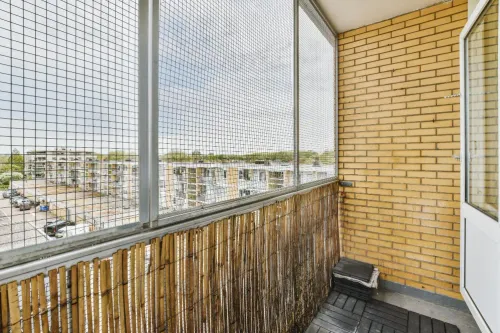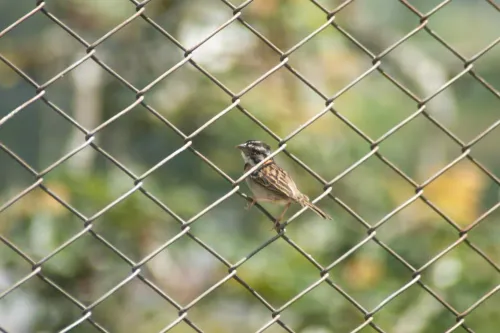

Pigeon problems often begin with occasional visits and gradually become a daily inconvenience. Once birds identify a sheltered balcony as a reliable resting or nesting place, cleaning alone may not prevent them from returning. Kabootar net jali is commonly used to restrict pigeon entry while keeping the balcony open to daylight and ventilation.
For apartment residents in Nagpur, Maharashtra, the key is determining whether netting addresses the actual pattern of bird activity and whether the proposed installation covers all relevant entry points.
Signs That Simple Cleaning Is Not Enough
Occasional bird activity may not require major intervention. Persistent activity is different.
A physical exclusion solution becomes worth considering when residents repeatedly notice:
- Droppings appearing soon after cleaning
- Nesting material in balcony corners
- Birds entering utility spaces
- Pigeons sitting around outdoor AC units
- Feathers accumulating frequently
- Repeated nesting attempts
- Difficulty using the balcony comfortably
These signs suggest that birds have regular access to the space.
Kabootar Netting Compared With Bird Spikes
Both products are used for bird control, but they solve different problems.
Kabootar netting blocks birds from entering a larger open area. It is therefore commonly used across balconies, shafts, and similar openings.
Bird spikes make narrow surfaces uncomfortable for perching. They are better suited to ledges, parapets, and projections.
If pigeons fly into the balcony, installing spikes on only one ledge may leave the underlying problem unresolved. Conversely, completely enclosing a location may be unnecessary when birds are merely perching on one exterior projection.
Observing bird behaviour before selecting a solution is therefore worthwhile.
What Makes a Net Installation Effective?
Coverage matters as much as the material itself.
A net can appear to cover most of a balcony while still leaving an entry gap around a pipe, corner, railing, or architectural projection. Pigeons can exploit accessible openings.
Installation planning should examine the complete perimeter, including difficult-to-see edges.
The net should also have appropriate tension. Excessive sagging can look untidy and may affect practical use of the balcony.
Consider Everyday Balcony Requirements
Before installation, think about how the space is used.
Does an AC technician need access to an outdoor unit? Is there a clothes-drying arrangement? Are plants positioned near the edge? Does building maintenance require occasional façade access?
These questions should influence the installation layout.
A bird-control system should solve one problem without unnecessarily creating another.
Hygiene Remains Important
Netting prevents future entry but does not automatically clean contamination already present.
Existing droppings, nesting debris, and feathers should be handled carefully. Residents should avoid creating airborne dust from dried droppings and should follow appropriate hygiene practices during cleaning.
Food sources should also be considered. Open waste or regular feeding around the building can continue attracting large numbers of pigeons to the property even when individual balconies are protected.
Assess the Balcony Before Choosing
No two balconies have exactly the same dimensions or architectural details. High-rise apartments, recessed balconies, utility spaces, and older buildings can each require different installation approaches.
UNIFIRST SALES AND SERVICES provides kabootar net jali installations for suitable properties across Nagpur. Site measurement helps identify the opening dimensions, fixing points, service-access needs, and other details that influence the installation.
For residents facing a persistent pigeon problem, the most effective approach begins with identifying how birds enter the space. When full-opening exclusion is appropriate, properly fitted netting can help restore the balcony as a cleaner, more usable part of the home.
Keywords